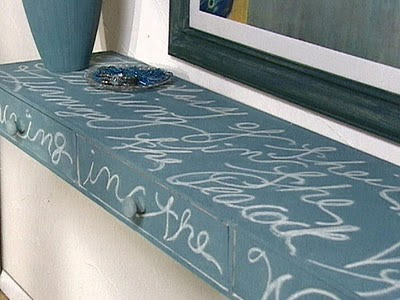
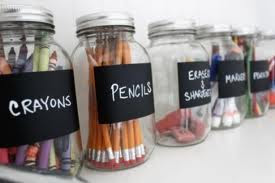
Do you textorate your home?

Saturday, February 19, 2011


Do you ever use numbers or letters as
decorative elements in your home?

W
hether through a lettered sign,
old numb
ered tags,
chalkboard messages,
or monogrammed towels or pillows ---
you may be "textorating"
and not even know it!

Here are some memorable ways to

incorporate letters
and numbers
into your
home or workspace.


Photo credits:
Many thanks to the following for posting their fantastic
visual images for us to share.
apartmenttherapy.com, desiretodecorate.com, embellish-vintageembellishments.blogspot.com, freshhome.com, casa-diseno-blogspot.com, craftstew.com, fancyseeingyouhere.blogspot.com, hgtv.com, myhomeideas.com, newyork.olx.com, realsimple.com, simplynatural.blogspot.com, rustybluebird.com, weedecor.com, shopshacksite.com


English Transferware Collections

Saturday, February 12, 2011


We love the designs and patterns of transferwa
re.
English transferware looks great in groupings on a sh
elf,
layered in a buffet or hutch, or mix and matched on a table settin
g
for a romantic meal.


A Brief History of Transferware

"English transferware" refers to ceramics -- china, ironstone, etc. -- which has been glazed using a specific decorative treatment traditionally produced in Staffordshire, England. Some of the more popular manufacturers of transferware included Spode, Ridgway, Adams, Clews, Johnson Brothers, and Wedgwood.


The transfer printing process was developed in 1756 using copper plates which were etched with a design. The plate was then inked and the pattern was "transferred" to a special tissue. The inked tissue is then laid onto a bisque-fired ceramic item, which would be glazed and fired again.

The transfer printing process caught on quickly and was later adopted by Josiah Wedgwood to create his popular, ivory based "Creamware". Prior to the development of transfer printing, only the most affluent English families could afford complete dinnerware sets, because every dish was carefully hand-painted by an artisan and thus, very expensive.

Transfer printing allowed hundreds of sets of plateware to be produced in a fraction of the time and cost of their hand-painted counterparts, and allowed middle-class families to have both utilitarian and decorative pieces for their homes. Transfer printing was originally produced in single-color items only, with the favorite hues in blue, red, black, brown, purple and green. Brown tended to be rather a common and inexpensive color, while blue was the most sought after and expensive color.

(Taken in part from Erasofelegance.com)


Do you have a collection of English transferware?

What color do you collect -- blue,

red, purple, black, brown, or green?


Photo credits include: Country Living, House Beautiful, Eclecticrevisited.wordpress.com, thetransferware.com, btchwstix.blogspot.com, goodlifeofdesign.blogspot.com, antiqueonline.ning.com, euroantiquemarket.blogspot.com, stonegable.blogspot.com, bonnesamies.com, flickr.com, cottagegardens.teresa.smith.blogspot.com

A new chapter for an old book

Friday, February 4, 2011


Have you ever had a box of old books
that you no longer have a use for?


How many of these boxes have you passed on
to your local library or school book drive?


If you think "out of the box" you can come up
w
ith a million ideas of how to reuse them.


Here are some of my favorite images of what creative geniuses have
come up with to re-purpose their box or boxes of old books.

Is there something special you have done with your old books?


Inspired by cookies??

Tuesday, February 1, 2011

Perhaps it is because it has been grey and cloudy for over a week here but I was looking for something light and cheery while online. I came across these photos and was instantly enthused. There is something about macaroons that are just so happy! Wouldn't you agree?!


These won the Melbourne Macaroon of the Year Competition!


Vintage suitcase, what's your story?

Monday, January 24, 2011


Who held your handle? Where did you go together?


Did you leave the country? Did you travel by plane, train, bus, ship, or maybe automobile?


Did your owner add their initials, a name plate,
or maybe some travel stickers to you?


And what are you made of? How did you close?
Did you have wheels or a celluloid handle?


We love old suitcases in any color, shape or size.

Stacked luggage makes a great side table.
When you have several, stack them in descending order
to create a great vertical column of storage.

In a small amount of space,
they add character and charm.

Stop by Blue Cardinal often as we always have
many different trunks,
suitcases and metal storage boxes for your collection.